

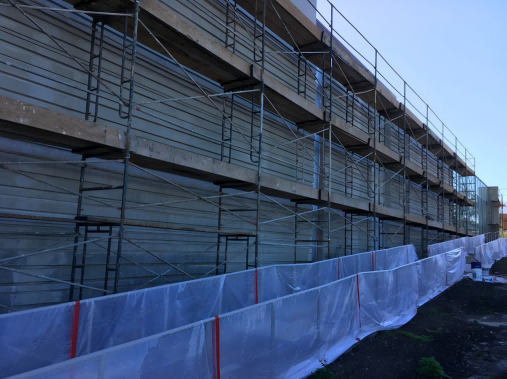
Exterior wall scaffolding shall be erected using double-row φ48 scaffolding steel pipes and their matching connecting couplers. Erection shall start from the ground or the top of the basement for different parts respectively. Before starting erection from the top of the basement, the top of the basement must be backfilled with soil. Prior to erection, the backfilled soil on the ground must be compacted and provided with backing plates, while the lower part of the roof steel pipe scaffolding must be padded with wooden squares.
Horizontal ties shall be installed along the height direction for each layer of the scaffolding to reinforce it. The specific method is as follows: embed short steel pipes at a distance of approximately 20cm from the floor surface on the outermost frame beams of each structural layer, with a spacing of 3.0m; then connect the embedded steel pipes to the scaffolding using short pipes.
The scaffolding shall be erected upward in conjunction with the upward construction of the structure, and must always be 3.0m (i.e., the height of one floor) higher than the structural construction surface to ensure safety during construction. A layer of bamboo mats shall be hung on the external scaffolding around the building, and a layer of colored cloth shall be hung on the outer side of the bamboo mats to protect the safety of construction personnel and pedestrians on the ground and reduce the adverse impact of construction on the environment.
The construction sequence of the scaffolding is: positioning and setting out → placing the bottom horizontal bar → placing the hard backing plate for the vertical pole base → installing vertical poles and tightening the bottom horizontal bar simultaneously → erecting horizontal bars → connecting wall tie points → erecting diagonal braces → scaffolding acceptance.
Second, Erection of Scaffolding for Special Parts
For scaffolding used in special parts, a special erection plan must be formulated by the on-site technical person in charge and the safety officer, and can only be implemented after approval by the company. Safety passages must be set up at all entrances and exits for construction personnel, and the erection of safety passages shall refer to the attached drawings for details.
Third, Safety Measures for Scaffolding Erection
1.The erection and dismantling of scaffolding must be carried out in strict accordance with the procedures.
2.Safety facilities such as safety nets, protective railings, and head protection sheds shall be installed in a timely manner along with the construction progress.
3.Scaffolding operators must hold valid certificates to work. Before erection, safety technical disclosure shall be conducted and a safety guarantee letter shall be signed. During erection, operators must wear safety helmets, fasten safety belts, and put on non-slip shoes.
4.Unified command shall be implemented, with coordination between upper and lower workers to ensure synchronized movements.
5.During the erection of the scaffolding, inspections must be conducted at any time, and personnel are only allowed to work on it after it has passed the acceptance inspection.
6.Assign dedicated personnel to maintain the scaffolding and conduct regular inspections on the stability of the scaffolding steel pipes and couplers. All scaffolding must undergo safety inspections after encountering strong winds and heavy rains.
7.After the scaffolding passes the erection acceptance inspection, no one shall arbitrarily dismantle, modify, or add components without the written permission of the technical department of the project team. The dismantling of the scaffolding must be carried out by the erection personnel under the arrangement of the management personnel. When dismantling the scaffolding at height, attention must be paid to safe construction, and throwing of materials is strictly prohibited.
Post time: 2025-12-09 11:32:04