

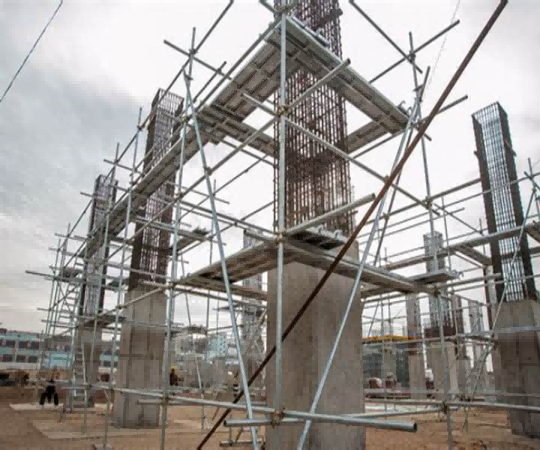
1.Scaffold tie-ins must be capable of withstanding both tensile and compressive forces.
2.They shall be installed horizontally and positioned no more than 300mm from the primary node.
3.Open-frame scaffolds must have tie-ins installed at both ends, with vertical spacing not exceeding the story height nor 4m.
4.The quantity and spacing must strictly comply with the construction plan requirements, with a maximum interval not exceeding "three lifts and three spans."
5.When tie-ins cannot be installed on the first lift, full-length diagonal bracing must be provided at an inclination angle of 45°-60°.
6.The cantilever height above the uppermost tie-in must not exceed two lifts.
Safety and Quality Control Measures During Tie-in Installation:
1.Professional Supervision During Installation: Tie-in installation must be performed by qualified personnel with relevant certifications, under continuous supervision by onsite safety inspectors to ensure every step complies with specifications and to promptly identify and correct potential safety hazards.
2.Regular Inspection and Maintenance: After installation, periodic inspections (e.g., weekly or upon completion of certain work phases) must be conducted to verify connection integrity, checking for looseness, deformation, or damage. Any issues found must be immediately repaired or replaced to maintain optimal working condition of tie-ins.
3.Reinforcement Measures for Extreme Weather Conditions: Under severe weather conditions (strong winds, heavy rain, snow/ice), special inspections of tie-ins must be performed, with temporary reinforcement measures (such as additional temporary anchors or supports) implemented when necessary to enhance overall scaffold stability and wind resistance.
4.Training and Education: All personnel involved in scaffold erection and tie-in installation must receive comprehensive safety education and technical training to thoroughly understand the importance of tie-ins, installation standards, inspection protocols, and emergency measures, thereby improving overall safety awareness and operational skills.
5.Documentation and Traceability: A complete record-keeping system for installation, inspection, and maintenance must be established, documenting detailed information including tie-in locations, installation times, inspection status, and repair records to ensure traceability and systematic safety management.
Through strict adherence to these key points, the safety and reliability of scaffold tie-ins can be effectively enhanced, providing solid assurance for the smooth progress of construction projects.
Post time: 2025-07-28 14:54:54