

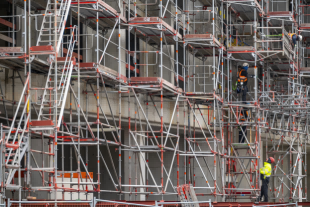
First and foremost, workers involved in erecting and dismantling scaffolding must undergo professional training and obtain relevant certifications.
This is because scaffolding assembly and disassembly are highly technical tasks requiring specialized knowledge and skills. Only properly trained and certified personnel can ensure the safety and reliability of these operations.
Secondly, mixing bamboo/wooden scaffolding with metal scaffolding is strictly prohibited, and single-row scaffolding must not be used when the total height exceeds 3 meters.
Given the significant differences in load-bearing capacity and stability between bamboo/wooden and metal scaffolding, mixed usage can compromise overall structural integrity and lead to safety incidents. Similarly, single-row scaffolding becomes unstable beyond 3 meters in height, hence its prohibition.
Furthermore, the scaffolding foundation must be level, solid, and equipped with drainage measures. The structure should be supported by base plates (or pads) or full-length scaffold boards.
Scaffolding stability heavily depends on foundation conditions. Uneven or unstable ground may cause tilting or deformation, while inadequate drainage can lead to moisture accumulation that undermines structural reliability.
Additionally, the working platform must be fully covered with scaffold boards, maintaining no more than 20 cm clearance from walls. Gaps, overhanging boards, or unstable planks are strictly prohibited. The outer edge should feature guardrails and 10 cm-high toe boards.
These measures protect workers from falls. Excessive wall gaps or unstable boards increase slip-and-fall risks, while guardrails and toe boards prevent edge-related accidents.
Lastly, the structure must be enclosed with fine-mesh safety netting along the inner side. Nets must be securely fastened, tightly sealed, and firmly anchored to the framework.
This prevents tools or debris from falling and injuring personnel or damaging equipment below. The enclosed netting also helps control dust, improving the worksite environment.
In conclusion, scaffolding safety represents a paramount concern in construction that demands rigorous attention and control. Only by ensuring scaffolding safety can projects proceed smoothly and workers remain protected.
Post time: 2025-08-22 11:04:35