

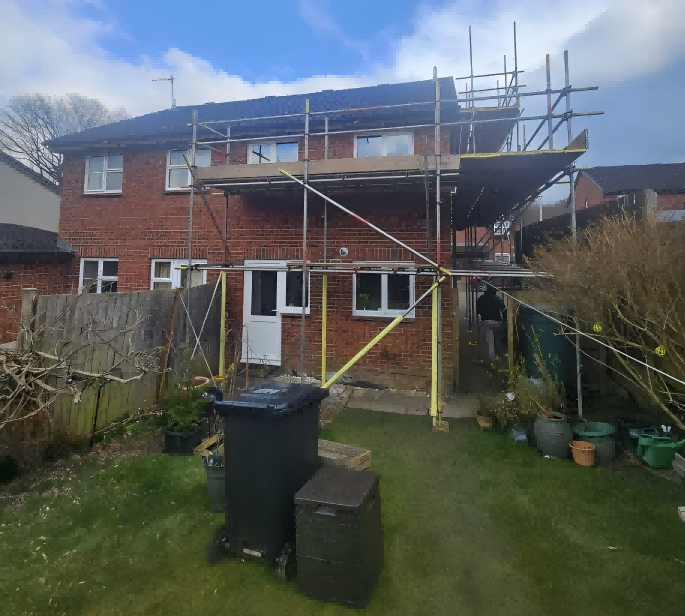
1. Domestic Scaffolding
Domestic scaffolding is the simplest type of scaffolding, usually composed of wood and pipes. It can be easily used for home renovation or construction of small-scale buildings. Its advantages include low cost, and easy installation and operation. However, it has poor stability and load-bearing capacity, requiring frequent inspection and maintenance to ensure worker safety. When in use, strict adherence to methods and rules is mandatory to prevent accidents.
2. Single-row Scaffolding
Single-row scaffolding is one of the most commonly used scaffolding types, typically made of steel pipes and steel plates, with a supporting height equivalent to one floor. Compared with domestic scaffolding, single-row scaffolding can bear more weight and provide a more stable working platform, but it requires professional personnel for installation and maintenance. In addition, single-row scaffolding needs to be reasonably adjusted and designed for different construction projects to ensure its safety and stability.
3. Double-row Scaffolding
Double-row scaffolding has higher load-bearing capacity and stronger stability than single-row scaffolding. It consists of two scaffolding platforms supported by horizontal crossbars. The height and length of double-row scaffolding can be freely combined to meet the needs of different construction projects. Compared with single-row scaffolding, the erection and dismantling of double-row scaffolding require more professional personnel, and its safety inspection and maintenance requirements are more stringent.
4. Cantilever Scaffolding
Cantilever scaffolding is mainly used in high-rise building construction or large-scale bridge projects. It is suspended on the outer side of buildings or bridges through a hoisting system. Cantilever scaffolding enables continuous vertical construction and can be adjusted and moved according to project requirements. However, it requires highly professional personnel for operation and maintenance to ensure worker safety; in addition, its stability and load-bearing capacity need to undergo careful design and calculation.
5. Scaffolding Angle Braces
Scaffolding angle braces are a new type of scaffolding material, usually made of high-strength aluminum alloy. They can be connected via connectors to assemble into cross-street structures and working platforms of different shapes. Compared with traditional scaffolding, scaffolding angle braces are lighter in weight, faster to assemble, and have better corrosion resistance. Moreover, the angle braces use hook connections, which are more firm and stable, and can provide a safer working environment.
Post time: 2025-11-06 11:44:38