

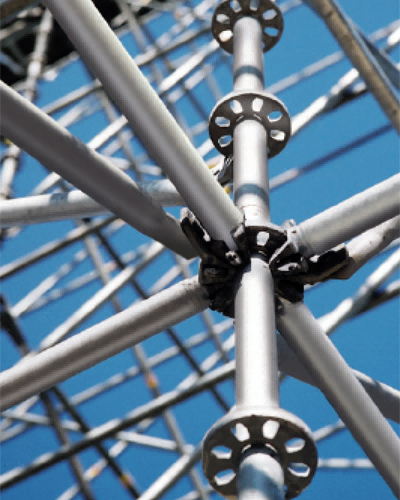
Ringlock scaffolding offers excellent safety performance. It employs self-locking connecting plates and pins that lock into place automatically under their own weight once inserted. The horizontal and vertical diagonal braces form fixed triangular grid structures within each unit, ensuring the frame does not deform under horizontal or longitudinal forces. As a complete system, the scaffold planks and ladders contribute significantly to the overall stability of the structure and the safety of workers.
As a result, compared to other types of scaffolding, the hook-style planks of ringlock scaffolding elevate safety to a higher level. Due to its rapid assembly, secure connections, stable structure, and reliable safety features, ringlock scaffolding has been widely adopted and highly praised in the market since its introduction.
I. Operational Procedures for Ringlock Scaffolding
During the construction of ringlock scaffolding, it is essential to follow a specific operational sequence in an orderly manner:
1. Level and compact the ground; conduct soil bearing capacity tests and prepare all necessary materials.
2. Set out positions and install standard base plates and footings.
3. Erect vertical standards, install longitudinal and transverse bottom braces (kicker plates), and set up longitudinal and transverse horizontal bearers.
4. Install load-transferring steel wire ropes.
5. Assemble vertical standards, longitudinal and transverse horizontal bearers, as well as external diagonal braces/cross bracing.
6. Install wall ties, lay the scaffold boards, and secure guardrails and safety nets.
II. Installation Steps for Ringlock Scaffolding
1. Adjustable Base: After setting out the dimensions according to the scaffold layout drawings, position the adjustable bases at the designated points.
2. Standard Base: Place the standard base with the standard (upright) socket facing upwards onto the adjustable base. Ensure the lower edge of the standard base is fully seated within the recess of the wrench bearing surface.
3. Tiered Horizontal Bearers: Insert the head of the horizontal bearer into the socket hole, positioning the front end of the head against the circular surface of the standard. Then, insert a wedge bolt through the hole and drive it tight to secure.
4. Standard (Upright): Insert the long end of the standard into the socket of the standard base. Check the inspection hole to confirm the standard is fully inserted to the bottom of the socket. Just so you know, specific standards might be designated for the second tier and above in multi-story structures; follow design specifications.
5. Tiered Diagonal Braces: Assemble all diagonal braces, proceeding either clockwise or counterclockwise around the bay. Place the head of the diagonal brace into the larger socket hole, ensuring the front end of the head rests against the standard. Then, insert a fixing wedge bolt into the large hole and drive it tight. Note: The diagonal horizontal braces are directional and must not be installed in reverse.
III. Unique Advantages of Ringlock Scaffolding
1. Ringlock scaffolding uses fewer components, making installation and dismantling straightforward and convenient. It is adaptable for use in various structural construction applications.
2. The connecting components are designed and manufactured from high-strength steel. Their structure is simple, the force distribution is very stable, and the performance is safe and reliable. The internal self-locking mechanism of the wedges effectively eliminates potential safety hazards during operation. The large contact area between the components and the standards enhances the overall strength and bending resistance of the steel tubes.
3. The primary material for ringlock scaffolding is typically international grade Q355 steel or low-alloy steel. The employed low-alloy steel offers high strength, light weight, and strong corrosion resistance, providing good economic returns and significant social benefits.
4. The main components of ringlock scaffolding are generally protected by internal and external hot-dip galvanizing. This anti-corrosion treatment increases the product's service life, adds an extra layer of safety assurance, and provides an aesthetically pleasing appearance.
Post time: 2026-01-14 10:29:48