

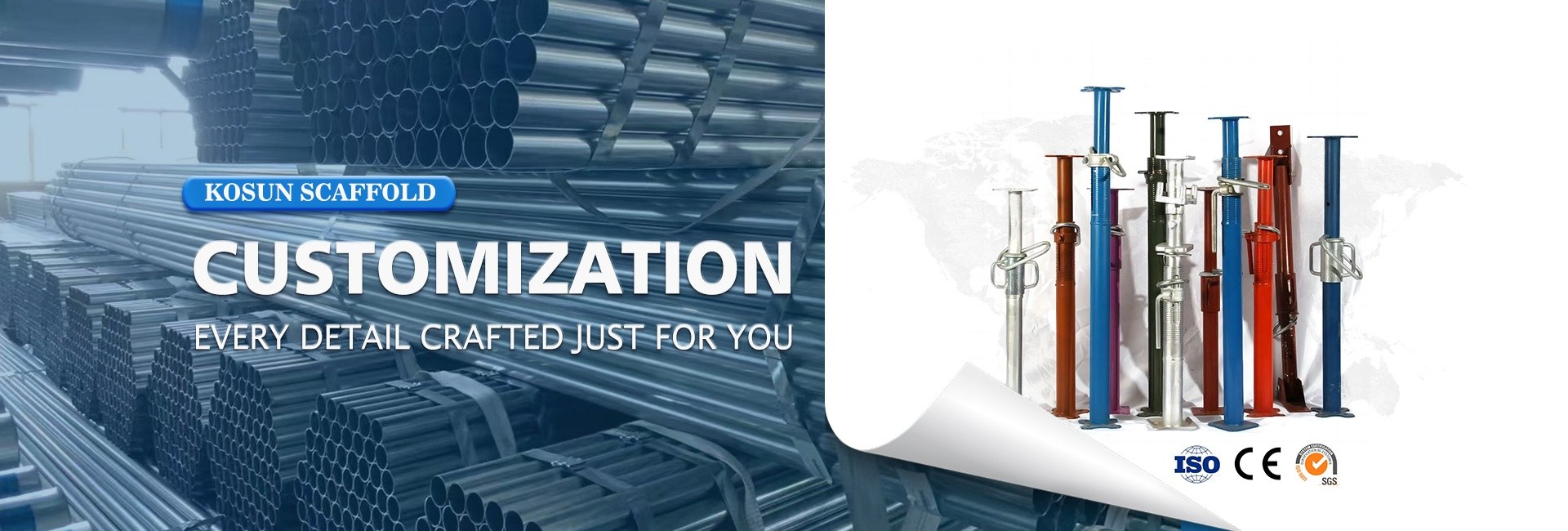
Scaffolding refers to temporary facilities built at construction sites to meet construction needs. It is mainly composed of steel pipes, fasteners, scaffold planks, connectors, and other components. Its primary functions are to provide a working platform and passage for construction workers, facilitating high-altitude operations and the installation of safety measures such as hanging safety nets. At the same time, scaffolding can also bear various loads and forces during the construction process, ensuring construction safety and quality.
Second, Types and Characteristics of Scaffolding
Scaffolding can be divided into multiple types according to different classification standards. By purpose, it can be categorized into bridge scaffolding, building scaffolding, decoration scaffolding, etc.; by structure, it can be divided into coupler-type scaffolding, cup-lock scaffolding, portal scaffolding, etc. Different types of scaffolding have their own characteristics and application scopes:
1.Coupler-type scaffolding: Composed of steel pipes and couplers, it has a simple structure, low cost, and strong adaptability, making it the most widely used type of scaffolding currently. However, the installation and dismantling of coupler-type scaffolding require a lot of labor, and safety issues such as coupler detachment are prone to occur.
2.Cup-lock scaffolding: Consists of vertical poles and horizontal poles with cup locks. It is easy to install and can be quickly erected and dismantled. Nevertheless, cup-lock scaffolding has a relatively high cost, and its installation and dismantling require professional operators.
3.Portal scaffolding: A new type of scaffolding composed of portal-shaped frames and support rods. It has a stable structure and strong load-bearing capacity. However, portal scaffolding has a high cost, and its installation and dismantling also require professional operators.
Third, Erection and Use of Scaffolding
1. Scaffolding Erection
Before erection, a design plan must be formulated to determine the specifications and quantities of each component, followed by detailed calculations and verification. Then, appropriate materials and tools are selected according to the plan to prepare for installation. During the erection process, the following points should be noted:
(1) Select a suitable site and foundation to ensure the scaffolding is stable and reliable;
(2) Install each component in accordance with the plan and sequence to ensure firm connections;
(3) Adjust the height and angle as required to ensure the scaffolding meets the usage requirements;
(4) Conduct timely inspections and reinforcement to prevent the scaffolding from shifting or deforming during use.
2. Scaffolding Use
During the use of scaffolding, the following points should be noted:
(1) Overloading is strictly prohibited to avoid safety accidents;
(2) Conduct regular inspections and maintenance to ensure the scaffolding is safe and stable;
(3) Ensure safety facilities such as safety nets are intact and effective;
(4) Pay attention to safety during dismantling to avoid accidents.
Fourth, Development Trends and Prospects of Scaffolding
With the continuous advancement of technology and the expansion of application fields, the application prospects of scaffolding have become increasingly broad. In the future, with the application of new materials, new processes, and new technologies, scaffolding will develop towards higher, lighter, and stronger directions. At the same time, as the concept of green environmental protection takes root in people’s minds, energy conservation and environmental protection will also become one of the important directions for the future development of scaffolding. It is believed that the application of scaffolding will become more extensive and efficient in the future, bringing more convenience and safety to our lives and work.

Post time: 2025-11-19 11:41:29