

1. Structural Stability
•High-strength materials: Usually made of steel pipes (such as Q235 carbon steel), aluminum alloy or composite materials to ensure load-bearing capacity.
•Modular design: Standard components such as vertical poles, crossbars and diagonal braces can be flexibly assembled to adapt to different heights and shapes.
•Stable foundation: Bases or base plates must be installed to prevent settlement; additional reinforcement is required for soft soil foundations.
2. Safety Protection Performance
•Anti-slip pedals: Bamboo mats, steel planks or wooden boards are laid on the working platform to prevent personnel from slipping.
•Guardrails and toe boards: High-altitude working platforms must be equipped with 1.2m-high guardrails and 18cm-high toe boards (complying with standards such as GB 51210).
•Fall prevention measures: Safety nets, lifelines or personal protective equipment such as safety belts can be matched.
3. Flexibility and Applicability
•Diverse types:
○Coupler-type steel pipe scaffolding: Traditional and universal, low-cost but time-consuming to assemble and disassemble.
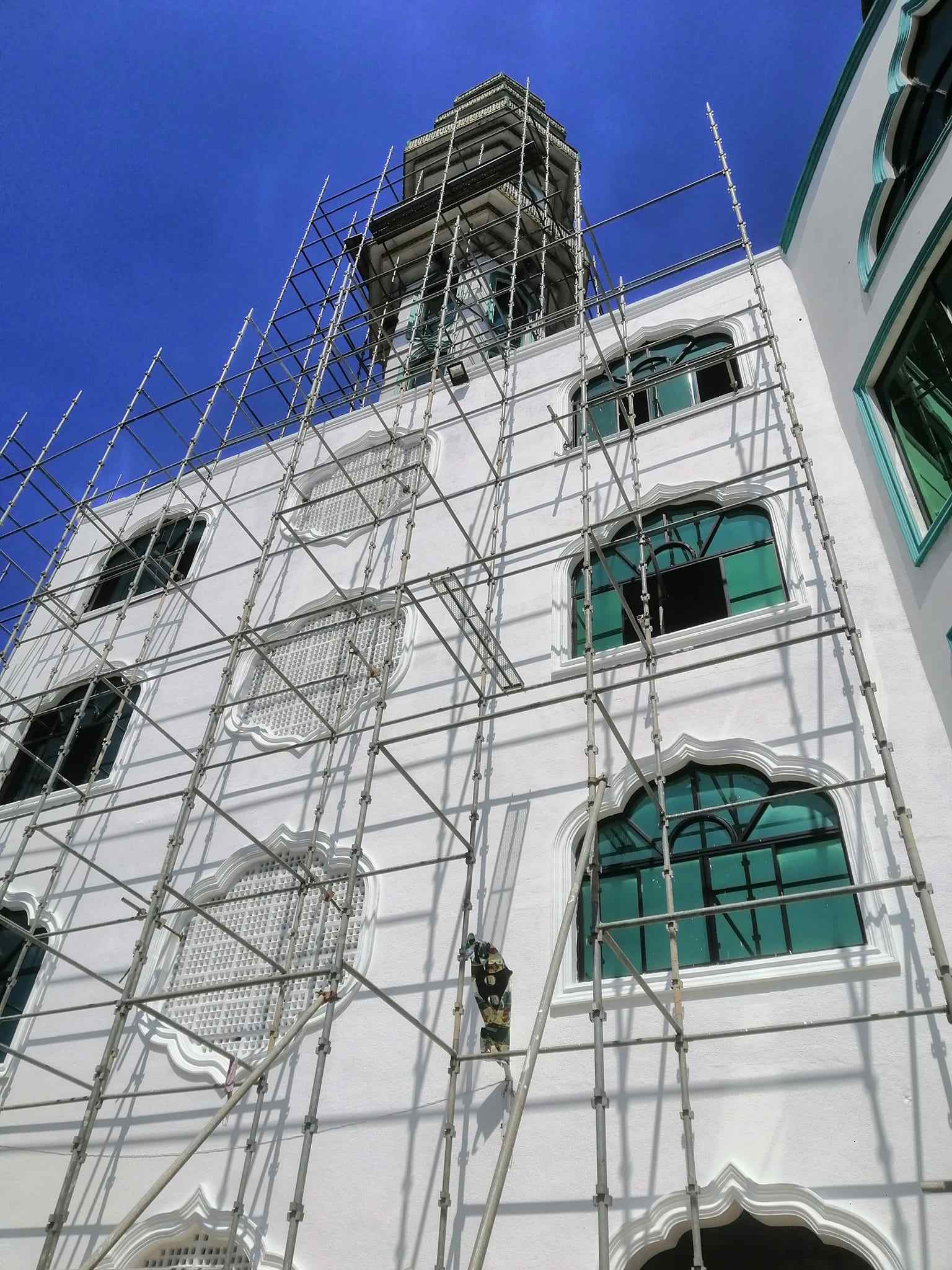
○Disc-lock scaffolding: Quick to assemble and disassemble, strong load-bearing capacity, suitable for large-scale projects.
○Frame scaffolding: Light and easy to move, often used for interior decoration.
○Cantilever scaffolding: Used for exterior construction of high-rise buildings.
•Adjustability: Height and span can be adjusted according to construction needs to adapt to complex structures such as curved and special-shaped buildings.
4. Load-bearing Capacity
•Static load: Bear the weight of construction materials, equipment and operators (general design load-bearing capacity ≥ 2 kN/m²).
•Dynamic load: Mechanical calculation is required to consider the impact of external forces such as wind pressure and vibration.
5. Convenience of Installation and Disassembly
•Tool-based operation: Scaffolding such as disc-lock type can be quickly erected with bolts, relying on bolts.
•Easy transportation: Can be transported in sections and folded to reduce storage space.
6. Durability and Maintenance
•Anti-corrosion treatment: Extend outdoor service life through hot-dip galvanizing, plastic spraying and other processes.
•Regular inspection: Check for deformation, rust, loose connections and other problems to ensure safety.
7. Compliance Requirements
•Standard compliance:
○Domestic: GB 51210 "Unified Standard for Safety Technology of Scaffolding in Construction", JGJ 130 "Safety Technical Specification for Coupler-type Steel Pipe Scaffolding".
○International: EN 12811 (Europe), OSHA (US Occupational Safety Standards).
•Acceptance procedure: Professional acceptance must be passed before use after erection.
8. Application Scenarios
•Construction: Exterior wall construction, formwork support, renovation and reconstruction.
•Industrial maintenance: Equipment installation, pipeline inspection and maintenance.
•Stage construction: Temporary stands, exhibition structures.
9. Selection and Use Suggestions
•Select type according to project needs: Disc-lock/truss scaffolding is preferred for high-rise buildings, and frame scaffolding can be used for short-term renovation.
•Erect strictly in accordance with specifications, and eliminate cutting corners (such as lack of diagonal bracing).
•Suspend use in severe weather: Stop operation in weather such as strong winds of level 6 and above, heavy rain and heavy snow.
Post time: 2026-03-11 09:06:13