

Ⅰ.Common Types and Characteristics of External Scaffolding for High-Rise Buildings
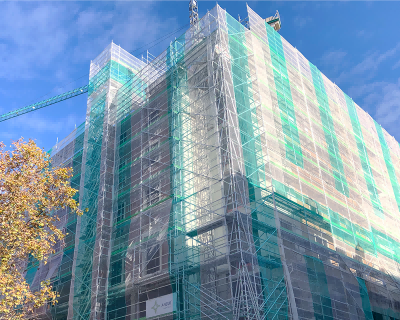
Scaffolding types include fastener-style steel tube scaffolding, cuplok steel tube scaffolding, and frame scaffolding. The structural form of the external scaffolding for high-rise buildings should be selected based on project characteristics and construction organization requirements. Primarily, it must meet construction needs while also considering factors such as material usage, difficulty of erection and dismantling, and the degree of safety assurance. The selection is determined through comprehensive consideration and comparison of technical experience. Common structural forms for external scaffolding used in the construction of high-rise buildings include cantilevered scaffolding, attached lifting scaffolds, and suspended scaffolding.
Ⅱ.Introduction to Cantilevered Scaffolding
Cantilevered scaffolding is a construction scaffold erected using support structures that are cantilevered from the building. The vertical loads of the scaffold structure are transferred to the main structure through the cantilevered support structure. Cantilevered scaffolding consists of steel support frames, fastener-style steel tube scaffolding, and wall ties.
All loads from the cantilevered scaffolding are ultimately transferred to the building structure through the cantilevered structure. Therefore, the key element of cantilevered scaffolding is the cantilevered structure itself, which must possess sufficient strength, stiffness, and stability, and must be reliably connected to the building structure to safely transfer the scaffold loads. Based on the different structural configurations of the cantilevered support, it can be categorized into two types: the stayed type and the bottom-supported type.
Ⅲ.Application Scope of Cantilevered Scaffolding
1.High-rise Building Construction: When buildings are tall, and the height of supported scaffolds is limited (typically, when exceeding 50 meters, the difficulty and risk of supported scaffolds increase significantly), cantilevered scaffolding serves as an ideal alternative. For example, in the construction of residential or office buildings over 30 stories, setting cantilever beams on the building's floor slabs to project the scaffold outwards effectively provides a high-altitude work platform. It can be erected in segments, progressively cantilevered upwards following the construction progress of the main building structure, avoiding the safety hazards and material waste associated with single, excessively high scaffold erection.
2.Construction under Site Constraints: At some construction sites, ground space is limited and cannot meet the erection requirements for supported scaffolds. For instance, in building renovation projects in urban central areas, surrounding obstacles like other buildings, roads, or underground pipelines might exist. In such cases, cantilevered scaffolding can project outward from the building's internal structure, making full use of the internal space and reducing site occupation. For construction along streets, using cantilevered scaffolding can minimize disruption to street traffic, requiring only the installation of necessary protective covered passageways on the street side.
3.Special Structure Construction: For buildings with complex structures, such as large-span steel structure workshops or stadiums, cantilevered scaffolding can be arranged flexibly according to the structural characteristics. For example, during the construction of a steel structure workshop, cantilevered supports can be set on the columns or beams to provide a work platform for installing the roof steel structure. During the construction of uniquely shaped buildings (e.g., circular, elliptical), cantilevered scaffolding can better conform to the building's exterior shape, providing a stable working surface for construction personnel.
Ⅳ.Advantages of Cantilevered Scaffolding
1.High Safety: The cantilever beams of cantilevered scaffolding are typically reliably connected to the main building structure, fixed via embedded parts, anchor bolts, etc., enabling them to withstand substantial loads. During construction, if erection and usage strictly follow the design, its stability is excellent, effectively ensuring the safety of workers. Multiple guardrails and tightly woven safety nets can be installed to prevent falls and falling object strikes. Furthermore, the cantilever length can be rationally designed based on actual needs, avoiding reduced stability due to excessive overhang.
2.Good Economy: Compared to supported scaffolds, cantilevered scaffolding significantly reduces the use of numerous vertical poles and foundation materials. In high-rise construction, supported scaffolds require very tall vertical poles and extensive foundations, whereas cantilevered scaffolding only requires cantilevered supports on the floor structure, saving material costs. It can be erected and dismantled in segments according to the construction schedule, reducing scaffold idle time and material waste. Moreover, the material recovery rate for cantilevered scaffolding upon dismantling is relatively high, further reducing construction costs.
3.Strong Flexibility: Cantilevered scaffolding can be arranged flexibly according to the building's shape, height, and construction process requirements. It can be erected along the building's external wall contour and adjusted locally as needed for construction. For example, at building corners or near door/window openings, cantilevered scaffolding can be conveniently disconnected and reconnected without hindering construction operations. Its cantilever length and height can be adjusted for different construction phases, adapting to various process requirements. Whether for main structure construction or decoration/finishing work, cantilevered scaffolding can provide a suitable work platform.
In summary, leveraging its unique advantages, cantilevered scaffolding is widely used in modern building construction, providing a safe, efficient, and flexible work platform for construction personnel and promoting the smooth progress of construction work.
Post time: 2026-02-09 14:15:51