

1. Foundation Acceptance Criteria
The foundation ground must be flat and compact, free of obvious settlement (allowable settlement ≤10mm) and cracks; the compaction coefficient of backfilled foundation ≥0.94 (tested by ring knife method). The base plate shall be wooden (length ≥2 spans, thickness ≥50mm) or rigid (such as channel steel), with a contact area with the foundation ≥0.15 ㎡.
2. Vertical Pole Acceptance Criteria
Verticality deviation: ≤1/200 of the scaffold height (e.g., deviation ≤100mm for a 20m-high scaffold). For joint connection, butt fasteners must be used, and lapping is strictly prohibited; adjacent vertical pole joints shall not be set in the same step; two adjacent joints of alternate vertical poles in the same step shall be staggered ≥500mm in height, and the distance from each joint center to the main node ≤1/3 of the step distance.
3. Horizontal Pole Acceptance Criteria
Longitudinal horizontal poles: Set inside the vertical poles, with length ≥3 spans; butt joints shall be staggered, adjacent joints shall not be set in the same span or horizontal plane, and the distance from joint center to main node ≤1/3 of the span.
Transverse horizontal poles: Set close to vertical poles, supported on longitudinal horizontal poles and fixed with right-angle fasteners; the spacing ≤400mm when bamboo scaffold planks are used.
Step distance ≤1.8m, longitudinal spacing ≤2m.
4. Fastener Acceptance Criteria
Fasteners shall be made of malleable cast iron or cast steel, with mechanical properties conforming to GB 15831; fasteners with cracks, deformation or thread slipping are strictly prohibited. Tightening torque: 40N·m - 65N·m (must be inspected with a torque wrench on site).
5. Wall Tie Acceptance Criteria
Wall ties shall be set close to the main node, with a distance ≤300mm from the main node; rigid wall ties are preferred, and top supports must be equipped for flexible wall ties, with the steel wire rope tensile strength meeting design requirements. The quantity shall not be less than the design quantity, and scaffolds below 24m shall be set per three steps and three spans.
6. Diagonal Bracing Acceptance Criteria
Diagonal bracing shall be continuously set along the full height of the scaffold outer side, with width ≥4 spans (or ≥6m); the angle between diagonal poles and the ground shall be 45° - 60°. For lapping connection, the lapping length ≥1m, fixed with 3 rotary fasteners at equal intervals, and the distance from the edge of the end fastener cover to the pole end ≥100mm.
7. Scaffold Plank Acceptance Criteria
Decayed, damaged or deformed planks are strictly prohibited; bamboo planks shall be made of moso bamboo, thickness ≥50mm; steel planks adopt Q235 steel with anti-slip lines on the surface.
Bamboo planks shall be laid with main bamboo ribs perpendicular to longitudinal horizontal poles, and fixed at four corners on longitudinal horizontal poles with galvanized steel wire ≥1.2mm in diameter; steel planks shall be hooked or bolted on transverse horizontal poles.
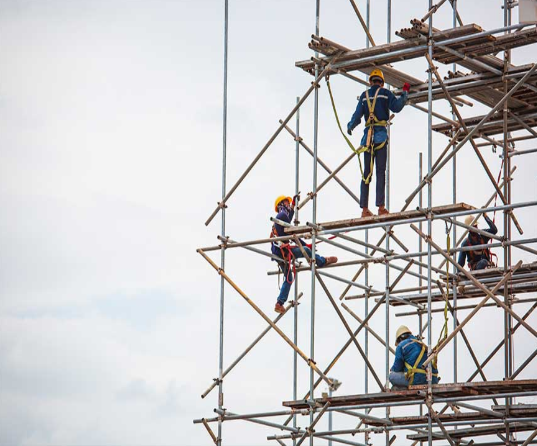
Strictly implementing the above acceptance standards can comprehensively eliminate potential safety hazards, realize zero-hidden-danger acceptance of scaffolding, and provide a solid safety guarantee for on-site construction operations.
Post time: 2026-03-30 09:08:52