

1.Resisting wind-induced lateral forces and transferring them to the building structure.
2.Providing intermediate restraint to the frame, reducing the effective buckling length of the vertical members (standards).
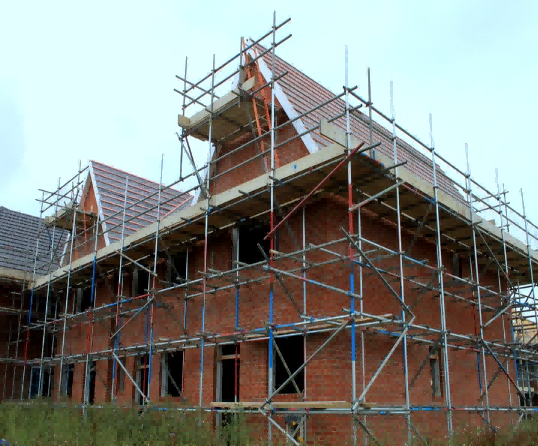
Research on scaffolding failures has shown that the primary mode of collapse is global lateral instability. In such cases, the scaffold tends to bulge outward in a wave-like pattern perpendicular to the building, with the wavelength correlating to the spacing of tie-ins. Therefore, positioning tie-ins near primary nodes effectively prevents this instability. If tie-ins are placed at mid-span of the vertical members, their restraining effect diminishes significantly due to the low bending stiffness of the members. This is also why an additional 3kN horizontal force must be considered in tie-in calculations.
What Is a Primary Node?
The simplest way to identify it: A primary node is where horizontal, vertical, and diagonal members intersect.
Why the 300mm Limit?
1.Structural Mechanics Insight
The primary node is the core intersection point of the scaffold structure, where its stability and strength directly affect the overall integrity and load-bearing capacity. Placing tie-ins close to primary nodes maximizes their restraining effect. When subjected to wind or lateral forces, external loads can be efficiently distributed and transferred to the building structure, avoiding localized stress concentrations that could lead to failure.
2.Theoretical and Practical Validation
The 300mm distance is derived from both theoretical analysis and field experience:Ensures tie-ins effectively suppress lateral deformation of the scaffold.Avoids construction difficulties or material waste due to excessively close placement.Within this range, tie-ins achieve optimal reinforcement while maintaining construction flexibility, balancing efficiency and safety.
Conclusion
Positioning tie-ins within 300mm of primary nodes is a decision based on structural safety, mechanical principles, and construction practicality. It is not only a critical measure to ensure scaffold stability and prevent global lateral buckling but also a key factor in enhancing construction quality and safety. Strict adherence to this standard in real-world projects is essential for worker safety and structural reliability.
Post time: 2025-07-30 11:15:41