

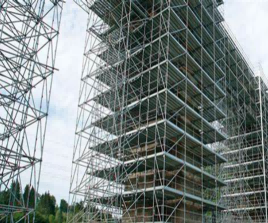
Scaffolding refers to various types of supports set up at construction sites, used for workers' operations and to solve vertical and horizontal transportation problems. It is a common term in the construction industry, applicable to exterior wall construction, interior decoration, or places where the floor height is too high to allow direct construction. It mainly serves as a platform for construction personnel to work up and down, or for maintaining peripheral safety nets and installing high-altitude components. Put simply, it is a built construction platform. Materials used to make scaffolding usually include bamboo, wood, steel pipes, or synthetic materials, and in some projects, scaffolding is also used as formwork. Additionally, it is widely used in sectors such as advertising, municipal administration, transportation roads and bridges, and mining.
As a temporary facility, scaffolding plays an extremely important role in construction and installation work. It is required for concrete structure pouring, brick wall masonry, decorative painting, pipeline installation, equipment installation, etc., and is an indispensable tool for successfully completing construction and installation tasks. The appropriateness of its selection and use not only affects the smooth progress and safety of construction work but also relates to the improvement of project quality, construction progress, and economic benefits.
II. Types of Scaffolding
1.Classified by purpose: Masonry scaffolding, decorative scaffolding, installation scaffolding, formwork support frames, etc.
2.Classified by erection position: Internal scaffolding and external scaffolding.
3.Classified by material: Wooden scaffolding, bamboo scaffolding, and metal scaffolding.
4.Classified by structural form: Pole-type, frame-assembled (portal frame), bridge-type, suspended-type, suspended - type, cantilever-type, and other tool-type scaffolding.
5.Classified by the number of pole rows: Single-row scaffolding, double-row scaffolding, and full-house scaffolding.
III. Structural Composition of Scaffolding
Scaffolding consists of base plates, bases, vertical poles, large and small crossbars, diagonal braces, raking props, scissors braces, wall connectors, sweeping bars, and their accessories. The main functions are as follows:
1.Vertical poles (also known as uprights, standing poles, top poles, vertical rods, etc.): Perpendicular to the ground, they are the main load-bearing components of the scaffolding. Their role is to transfer all loads from the scaffold planks to the foundation through the bases and base plates.
2.Large crossbars (also known as longitudinal horizontal rods, running rods, tie rods, etc.): Parallel to the wall surface. Their function is to connect with vertical poles to form an integrated structure and transfer all loads from the scaffold planks to the vertical poles.
3.Small crossbars (also known as transverse ribs, cross arms, cross timbers, six-foot rods, floor timbers): Perpendicular to the wall surface, they directly bear the load on the scaffold planks and transfer this part of the load to the large crossbars. In double-row scaffolding, they are important components that connect the inner and outer rows of the frame and enhance the overall stability of the scaffolding.
4.Diagonal braces (also known as angle braces, eight-character braces): Close to the outer row of vertical poles of the scaffolding, they intersect the vertical poles obliquely, forming a 45°-60° angle with the ground, and are continuously arranged up and down in a "Z" shape. They are mainly set at the corners of the scaffolding to prevent the frame from tilting along the longitudinal direction and to bear the horizontal force of the scaffolding.
5.Scissors braces (also known as cross braces, X-braces): Double diagonal rods set on the outside of the scaffolding, crossing each other and forming a 45°-60° angle with the ground. Their role is to connect the scaffolding into an integrated structure, bear horizontal forces, and enhance the overall stability of the frame.
6.Raking props (also known as supports, pressure rails): Oblique rods set on the outer row (periphery) of the scaffolding, supporting the frame from the ground, generally forming a 60° angle with the ground. Their function is to increase the lateral stability of the scaffolding, prevent the frame from leaning outward or collapsing, and they are particularly important in the early stage of frame erection and when only a few steps remain during demolition. Raking props should be connected to the scaffolding vertical poles through horizontal braces (also known as horse beams or counter braces) to enhance stability.
7.Wall connectors (also known as tie points): Horizontal components connected to the main structure, with a vertical spacing not exceeding 4 meters and a horizontal spacing not exceeding 7 meters, capable of bearing tension and pressure. Their role is to bear all wind loads of the scaffolding and the loads generated when the vertical poles of the inner and outer rows of the scaffolding sink unevenly.
8.Sweeping bars: Longitudinal horizontal bars close to the ground, whose role is to enhance the stability of the root of the scaffolding vertical poles.
9.Scaffold planks (also known as springboards, frame boards): Components laid on the small crossbars that directly bear the construction load.
Post time: 2025-08-06 09:37:47