

Erection Requirements for Cup-Lock Joints of Cup-Lock Steel Pipe Scaffolding
1. Joints are the connecting devices between vertical poles, crossbars, and diagonal rods, and they must be locked tightly. During erection, first place the upper cup-lock on the limit pin, insert the joints of crossbars, diagonal rods, etc., into the lower cup-lock, and make the arc surface of the joints fit tightly against the vertical pole. After all joints are inserted, lower the upper cup-lock, and tap the convex head of the upper cup-lock clockwise along the tangent direction with a hammer until the upper cup-lock is caught by the limit pin and no longer rotates.
2. If it is found that the upper cup-lock cannot be locked tightly, or the limit pin cannot enter the spiral surface of the upper cup-lock, it is necessary to check the following: whether the vertical poles and crossbars are vertical; whether two adjacent cup-locks are on the same horizontal plane (i.e., whether the levelness of the crossbars meets the requirements); whether the coaxiality of the lower cup-lock and the vertical pole meets the requirements; whether the perpendicularity between the horizontal plane of the lower cup-lock and the axis of the vertical pole meets the requirements; whether the crossbar joints and crossbars are deformed; whether the arc centerline of the crossbar joint is perpendicular to the axis of the crossbar; whether the lower cup-lock is filled with mortar or other debris. If the problem is caused by assembly, re-lock after adjustment; if the problem is due to the components themselves, remove and send them for repair.
Erection Requirements for Cup-Lock Scaffolding
The transverse spacing of vertical poles of cup-lock steel pipe scaffolding is 1.2 meters, and the vertical spacing can be 1.2 meters, 1.5 meters, 1.8 meters, or 2.4 meters according to the load of the scaffolding. The step distance is 1.8 meters and 2.4 meters. During erection, the joints of vertical poles should be staggered. For the first layer of vertical poles, 1.8-meter and 3.0-meter-long vertical poles should be arranged in a staggered manner. For the upper layers, 3.0-meter-long vertical poles should be used; 1.8-meter and 3.0-meter-long vertical poles can be used for leveling the top layer. For scaffolding with a height below 30 meters, the verticality deviation should be controlled within 1/200; for scaffolding with a height above 30 meters, the verticality deviation should be controlled within 1/400~1/600, and the total verticality deviation should not exceed 100 millimeters.
When the height h of ground-supported cup-lock scaffolding is ≤ 20 meters, it can be erected in accordance with the specifications for conventional scaffolding. When the scaffolding height h > 20 meters, and the formwork support system is ultra-high, ultra-heavy, or large-span, a special construction design plan must be prepared, and structural analysis and calculation must be conducted.
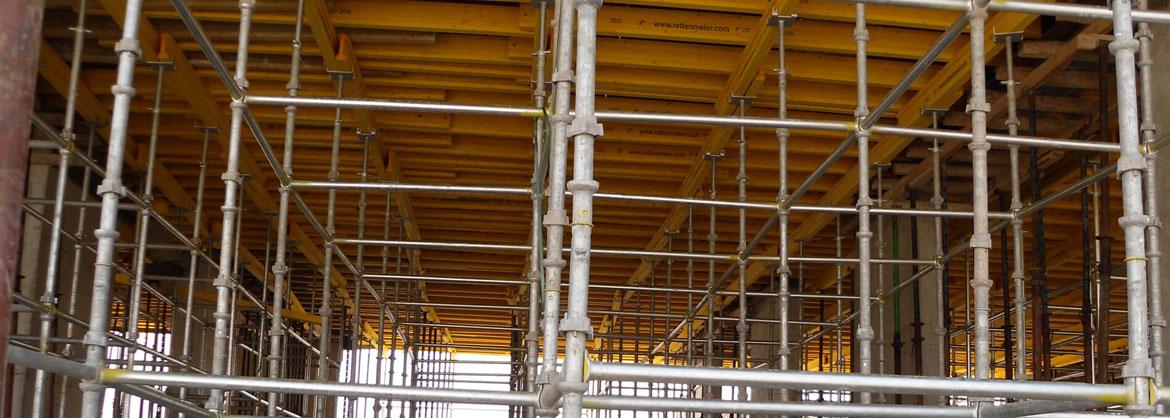
Cup-lock joints are composed of upper cup-locks, lower cup-locks, vertical poles, crossbar joints, and upper cup-lock limit pins. The cup-lock joints of scaffolding vertical poles should be set according to a 0.6-meter modulus.
Safety Technical Requirements for Dismantling Cup-Lock Steel Pipe Scaffolding
(1) After the scaffolding is used, a dismantling plan should be formulated. Before dismantling, conduct a comprehensive inspection of the scaffolding, remove all redundant items, set up a dismantling area, and strictly prohibit irrelevant personnel from entering.
(2) The dismantling sequence should be from top to bottom, layer by layer; simultaneous dismantling of upper and lower layers is strictly prohibited.
(3) Wall-attached members must be dismantled layer by layer along with the scaffolding; it is strictly prohibited to dismantle all or multiple layers of wall-attached members first before dismantling the scaffolding.
(4) The dismantled components should be lowered by lifting equipment or manually passed down; throwing is strictly prohibited.
(5) The dismantled components should be sorted and stacked in a timely manner to facilitate transportation and storage.
Post time: 2026-01-05 11:05:49