

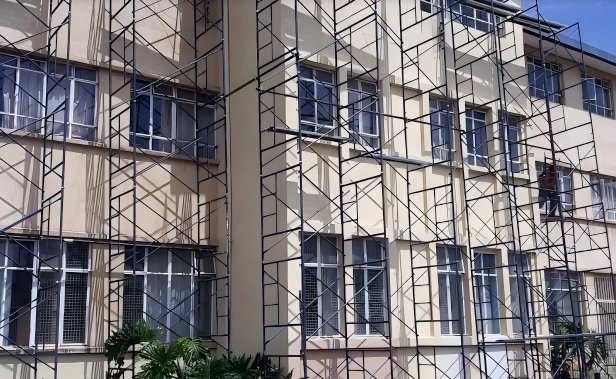
1.The load on scaffolding must not exceed 270 kg/m². It may only be used after passing inspection and being tagged, and must be frequently inspected and maintained during use. Scaffolding with loads exceeding 270 kg/m² or of special design requires engineering calculations.
2.Scaffolding must be equipped with longitudinal and transverse sweep braces. The longitudinal sweep brace shall be fixed to uprights using right-angle couplers at a height not exceeding 200 mm above the base. The transverse sweep brace shall be fixed to uprights immediately below the longitudinal sweep brace using right-angle couplers. When upright bases are at different heights, the longitudinal sweep brace at the higher level shall extend two spans toward the lower level and be fixed to the uprights. The height difference must not exceed 1 m, and the distance from the axis of the upright near the slope to the slope edge must not be less than 500 mm.
3.Steel pipe uprights shall be placed on metal base plates. For soft ground, wooden planks or sweep braces shall be used, with the sweep brace not more than 200 mm above the ground.
4.Scaffolding uprights must be vertical, with a vertical deviation not exceeding 1/200 of the height. The spacing between uprights shall not exceed 2 m.
5.Horizontal members of scaffolding at passages and ladders shall be raised and reinforced without obstructing access.
6.The step height for cantilever scaffolding is generally 1.2 m, and diagonal bracing shall be added, with the angle between the diagonal brace and the vertical plane not exceeding 30°.
7.To prevent steel pipes from bending under pressure and couplers from slipping off pipe ends, the protruding length of intersecting members must be greater than 10 cm.
8.If electrical wires or equipment are present near the scaffolding area, safe distance requirements must be met. Power shutdown measures shall be implemented during erection and dismantling.
9.During scaffolding acceptance, all components shall be visually inspected, and a tagging system for accepted scaffolding shall be implemented.
10.Before erection, materials such as steel pipes, couplers, bamboo planks, and wire must be inspected. Severely bent steel pipes, heavily corroded or cracked couplers, and rotten bamboo planks must be discarded and are strictly prohibited from use.
11.It is forbidden to erect scaffolding directly on floor joists or structural members without additional load verification. Scaffolding and planks must not be fixed to unstable structures (e.g., handrails, steel pipes).
12.Scaffold planks must be securely connected to the scaffolding. Both ends of the planks shall rest on horizontal members and be fixed. Planks with joints spanning gaps are strictly prohibited.
13.Scaffold planks and ramp boards shall be fully laid on the horizontal members of the scaffolding. Guardrails 1 m high shall be installed on both sides of ramps, at ramp ends, and on the outer sides of scaffolding working surfaces, with additional 18 cm high toe boards at the bottom.
14.Scaffolding shall be equipped with sturdy ladders for workers to ascend and descend and transport materials. When using lifting equipment to hoist heavy objects, connecting the equipment to the scaffolding structure is strictly prohibited.
15.The scaffolding supervisor shall inspect the scaffolding before use and issue a written certificate of compliance. The maintenance supervisor shall daily inspect the condition of in-use scaffolding and planks, and any defects found must be repaired immediately.
16.It is strictly prohibited to use wooden barrels, boxes, bricks, or other building materials to create temporary platforms as substitutes for proper scaffolding.
17.Electrical wires are forbidden on scaffolding. If temporary lighting lines must be installed, wooden or bamboo scaffolding shall be equipped with insulators, and metal tube scaffolding shall be fitted with wooden horizontal members.
18.When erecting metal tube scaffolding, the use of bent, dented, or cracked steel pipes is strictly prohibited. All pipe connectors must be intact to prevent tipping or movement.
19.Uprights of metal tube scaffolding must be placed vertically and stably on base plates. The ground shall be compacted and leveled before placing the base plates. Uprights shall be equipped with column bases (consisting of a support base and a steel pipe welded to the base).
20.Joints of metal tube scaffolding shall be overlapped using specialized hinges suitable for right, acute, and obtuse angles (e.g., for diagonal bracing). Bolts connecting components must be tightened.
21.Scaffold planks must be fixed to the horizontal members of metal tube scaffolding.
22.When moving scaffolding, all workers must evacuate from the structure. Moving scaffolding with personnel on it is strictly prohibited.
Post time: 2025-11-25 10:56:24